
Care at home can protect care in hospital

In his Labour Conference speech this week, Andy Burnham spoke about social care through the experience of his own family. He described what happened when his grandmother needed care, then widened the lens to the pressure poor care provision places on families, care workers and the NHS. He also made a simple but important point: when support outside hospital is not working, the consequences show up inside it, in ambulance demand, A&E admissions and people remaining in hospital longer than needed.
Social care and clinical homecare are different services, with different roles and responsibilities. But the speech made me think about a broader principle that applies to both: what happens outside hospital has a direct impact on what happens inside it.

That is easy to see when you bring it down to the level of one patient.
Imagine someone living with MS who needs regular treatment. For them, receiving an IV infusion at home rather than travelling into hospital could mean avoiding a journey, finding somewhere to park, sitting in a waiting room and organising work or family life around an appointment. Or think about someone who has been taught to self-administer a COPD treatment injection at home. What changes for that person may seem quite obvious: greater independence, less travel and less time spent as a patient. These are important benefits.
But I think the impact of clinical homecare reaches much further than the person sitting on their sofa receiving treatment.
When care that would otherwise take place in hospital can safely and appropriately happen at home, it changes something at the other end of the system too. A treatment chair in a clinic or hospital can be used by someone else. Clinical time can be focused where specialist hospital expertise is most needed. Space, pharmacy capacity and the wider infrastructure around an appointment can be used for patients whose care genuinely needs to happen there.
Multiply those individual decisions across many patients and pathways, and something that begins with one person at home starts to look like part of the answer to a much bigger question about NHS capacity.
When we talk about moving care closer to home, it is easy to frame the benefit primarily around convenience. For people living with long-term conditions, repeated hospital visits can have a significant impact on working lives, families and simply getting on with life. Treatment at home can remove some of that disruption. But if we stop there, we underestimate its value.
The benefit is not only experienced by the patient receiving care at home. The benefit extends to the patient who needs hospital care, the specialist teams that care for them, the diagnostic equipment required to guide their treatment and the acute bed they may need that day.
The question is not limited to how much care we can move out of hospital. It is how much hospital care we can unlock by delivering the right care at home.
Hospital will always be the best place for many patients and many treatments. The aim should never be to move activity simply because it can be moved, or because doing so releases capacity. The starting point has to be clinical appropriateness and patient need.

No single home treatment is going to solve the capacity challenge facing the NHS. But healthcare systems are ultimately made up of thousands of individual interactions.
One person avoids an unnecessary hospital journey. One chair becomes available. One clinical team has more time. One hospital visit does not need to take place. And then another.
The cumulative effect is where this becomes interesting.
Clinical homecare can help create capacity without asking hospitals simply to work harder within the same physical constraints. It allows us to think differently about where clinical capacity exists in the first place. The home can become part of that capacity, provided we connect it properly to the rest of the healthcare system.
Connected care cannot mean simply taking an appointment that used to happen in a hospital and recreating it behind someone’s front door. The NHS clinical team needs appropriate visibility and oversight. Information needs to move with the patient and be updated in real time as a single patient record. Changes in symptoms, adherence or treatment response need to be monitored. There needs to be clear routes back into NHS services when circumstances change.
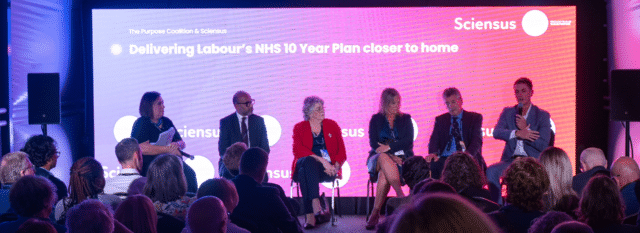
At Sciensus, that is what we mean when we talk about Connected Care: creating links between hospital, community and home so that care outside the hospital becomes an integral part of the patient’s wider clinical pathway, rather than becoming disconnected from it.
Done well, the benefit can work in both directions. The person at home receives care in a setting that may fit much better around their life. And the hospital retains more of its specialist people, places and infrastructure for the patients who need them most. Perhaps that is the bigger opportunity in the shift towards care closer to home.
Clinical homecare can make life easier for the patient sitting on their sofa. But its impact does not stop at their front door. It can help deliver better hospital care for everyone.