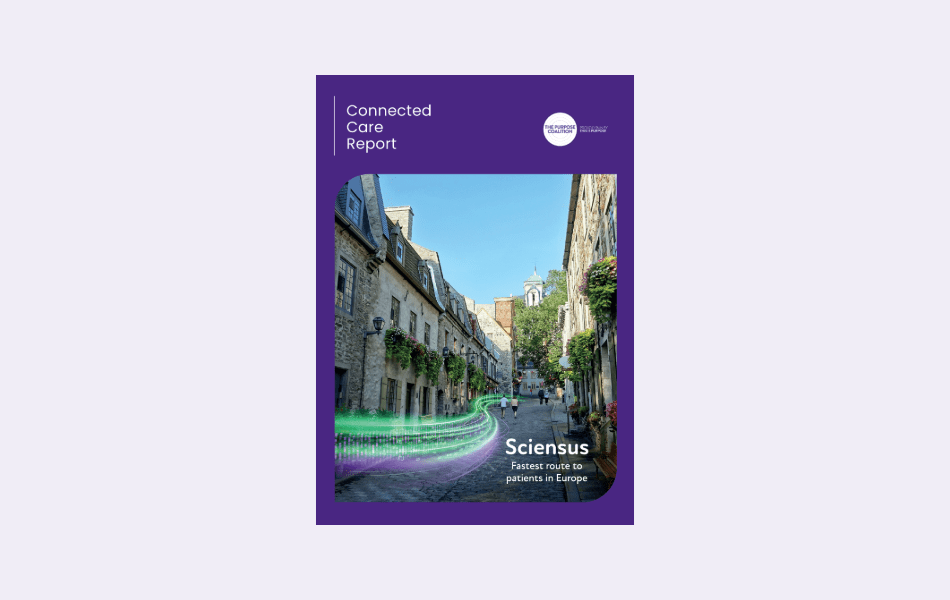

Bringing the Connected Care report to the UK Parliament
Today at the House of Commons at the Palace of Westminster, Sciensus is launching its Connected Care Report with The Purpose Coalition to show how more specialist care can be delivered safely at home. The aim is simple: help policymakers see that clinical homecare is already working, and that it should play a bigger role in the future of the NHS.
The Purpose Coalition is a high-profile, cross-party initiative that brings together businesses, policymakers and community leaders to break down barriers to opportunity across the UK. Its opportunity and social mobility framework provides a useful lens for understanding how access to healthcare connects to people’s wider life chances.
As Rt Hon Justine Greening, Chair of The Purpose Coalition, puts it: “Access to healthcare affects more than people’s health. It shapes whether they can stay in work, continue their studies and take part in everyday life. This report adds urgency to a discussion the UK needs to have if it is serious about opportunity and long-term growth.”

The hidden cost of care
For many people, healthcare still means travelling to hospital again and again for treatment. But that is not always necessary. In many cases, people can receive specialist care at home, including some chemotherapy, with the support of trained clinicians and the right digital tools.
That matters because treatment affects much more than health alone. When care is easier to access, people are more likely to stay in work, stay in education and keep some normality in family life. Recent polling behind the report shows this clearly: 71% of people said they would be more likely to stay in work or education if they could manage their condition at home.
The research also shows there is still a big gap in public awareness. Most people do not realise that some complex treatment can already be delivered at home, with 88% unaware that chemotherapy can sometimes be given this way. At the same time, 57% said travel and parking are major hidden costs of care, which is just an example of the additional burden hospital-based treatments can be on patients and families.
Supporting the NHS 10-Year Plan
For the NHS, connected care is not just better for patients. It can also ease pressure on hospitals. When suitable care moves into the home, it can reduce unnecessary hospital visits, free up beds and staff time and help the system focus on people who most need acute care. The report demonstrates that this makes clinical homecare a practical way to support the NHS direction of travel: more care closer to home and better use of digital tools.
Sciensus already delivers this kind of care at scale, supporting hundreds of thousands of patients each year across cancer, rare disease and long-term conditions. The message from today’s event is that this is not a future idea or a pilot. It is something that can be used more consistently now.
Our ask is straightforward: when national and local leaders make decisions about healthcare services, clinical homecare should be part of the conversation from the start. If the NHS wants to deliver more care closer to home, then connected care should be incorporated into the solution.
Want to learn more?
The Connected Care Report, developed by Sciensus in partnership with The Purpose Coalition, shows how delivering complex, specialist treatment at home can improve patient experience, reduce pressure on hospitals and support wider opportunity by helping people stay in work, education and family life.