
Three voices, one journey: How personalised cancer care changes lives
Sciensus provides in-home clinical care for cancer patients including systemic anti-cancer therapy (SACT) administration, clinical nurse specialist support and coordination with hospital consultants to deliver personalised, patient-centred care.
When George received his fifth cancer diagnosis in October 2024, living eight miles outside Belfast, he faced a familiar dilemma: months of chemotherapy would mean three full days every fortnight at the cancer centre.
“That sort of just hits you straight away, no matter how many times you go,” George recalls. “You can never get used to it.”
But this time was different. George received his chemotherapy at home with Sciensus.
The patient perspective: A life-saving catch
Midway through treatment, George’s right arm began to swell. Worried that an infection would halt his treatment and force him back to the cancer centre, he said nothing.
“I thought, I’ve got an infection here and I’ll say nothing and hopefully it’ll go away,” he admits. “That was my greatest fear – having to go back into the cancer centre.”
When one of the nurses arrived for routine bloods, she immediately noticed something was wrong. She measured his arm and rang the hospital. They discovered three blood clots.
The consultant was blunt: “Best case scenario, you would have had a serious stroke. Worst case scenario, it could have killed you.”
The clinical perspective
For Clinical Nurse Specialist Edel Pilling, who supports nine consultants across Northern Ireland covering breast and bowel cancers, this vigilance is what patient-centred care means in practice.
“I’m there to support patients physically with any side effects, financially if they have worries and be that go-between with the patient and the consultant,” Edel explains. Her role extends far beyond administering treatment – managing dose adjustments, coordinating with consultants and providing emotional support.
“Even when I’m going into clinics with the consultant, we discuss patients, go through their prescriptions. If patients are in hospital, we go round and see them. The consultants email me if there’s any concerns – ‘Could you contact a patient just to check in?’”
For Edel, the relationships that develop are what make the work meaningful. “Patients say it’s really invaluable to have somebody at the end of the phone. That gives them such a sense of comfort and support at a time where it’s very unsure.
“If I don’t know, I can’t help,” she adds.
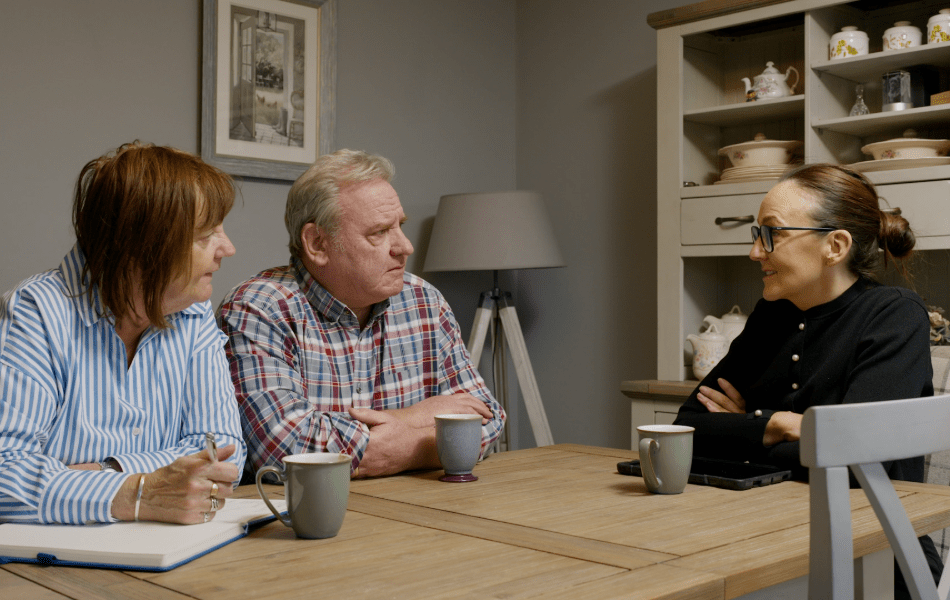
The family perspective
Tracey describes herself as a “silent sufferer” – the partner who must stay strong while watching someone they love face cancer.
“You have to stay in control because you know the person going through this is facing it with fear and worry. You’re the person who has to be strong for them.”
Having treatment at home meant Tracey could be fully involved. “Your mind as a patient isn’t always on what you need to listen to, so I was there to do that for him. I could take notes and sort out medication because my mind is more sound than his while he’s going through treatment.”
The nurses actively included Tracey in every visit. “Knowing that at the end of the phone they were there if I needed them – the reassurance with that is really, really good.”
Rural healthcare challenges
George’s story highlights a challenge facing cancer patients across rural Britain. Access to treatment remains a significant barrier, with some patients facing hours of travel for each appointment.
This issue has gained national attention, with the government’s recently announced 10 Year Health Plan specifically targeting health inequalities in rural and coastal communities. Home-based treatment models like the one George accessed offer a practical solution to these geographic barriers.
“There are cases where people have decided not to have treatment because the stress and hassle of having to get to the treatment centres,” George notes. He recalls one woman who required two to three bus trips to reach her treatment centre and decided she couldn’t continue. “The chemo could have been successful, but she decided rather than face the stresses of the travel, she wasn’t going to continue and she passed away.”
Having treatment at home removed those barriers. George was able to maintain his work promoting cancer awareness in farming communities throughout his treatment. “I was able to focus my mind on the work that I do. I use myself as an example – I’m quite open about it because I feel I have the credibility.”
And George continues his advocacy with conviction: “One in two people will face a cancer diagnosis in their lifetime. Early diagnosis is the difference between life and death. Simple as that.”
United by unique
This year’s World Cancer Day theme, “United by Unique,” recognises that every cancer journey is different and effective care must be personalised to each patient’s circumstances.
George’s story demonstrates this in practice: clinical excellence delivered with compassion, treatment adapted to life circumstances, families included as partners in care and barriers to access removed.
“The nurses became part of the family,” George reflects. “They knew all about my family, my grandchildren. There was flexibility. That made a very difficult situation more bearable.”
For Edel, this relationship is what drives her work. “It’s a real privilege. For people going through probably the worst time in their life to be welcomed into their home and be such a part of the family – there’s really nothing more you could want in a job.”
Tracey’s advice is simple: “If you have the opportunity to get treatment at home, it’s just a no brainer. Just go for it.”
George is one of thousands of patients our clinical teams support each year. Stories like his remind us of the value that personalised, in-home clinical care brings – not just in clinical outcomes, but in dignity, family involvement and quality of life during treatment.