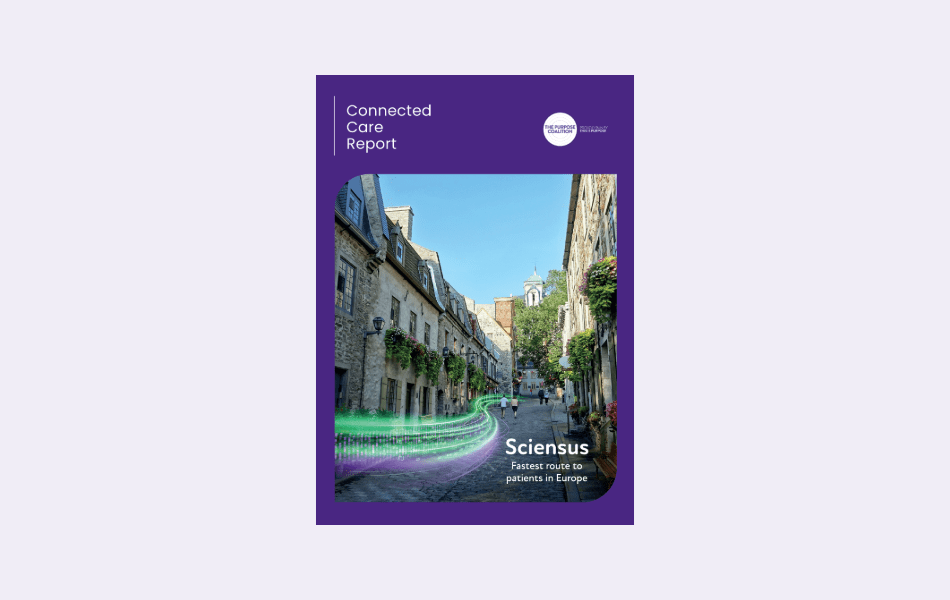
Connected Care: What our new report means for cancer care at home
Earlier this month, Sciensus brought its Connected Care Report to the House of Commons, in partnership with The Purpose Coalition, to show how clinically led homecare can support the NHS and expand access to specialist treatment closer to home.
Parliamentarians, healthcare leaders and patient representatives joined the discussion on how moving more appropriate care into the home can ease pressure on hospitals while improving outcomes and experience for people living with cancer and other complex conditions.
What the Connected Care report shows
The Connected Care Report brings together polling, patient insight and service data to demonstrate the wider impact of delivering complex treatment at home, including systemic anti-cancer therapies in suitable cases.
Patients told us that when they can manage their condition at home, they are more likely to stay in work or education and maintain some normality in family life, highlighting how care models directly influence opportunity, not just health.
The research also exposes a major awareness gap: 88% of people did not know that chemotherapy can sometimes be given safely at home under the care of trained clinicians.
At the same time, 57% cited travel and parking as significant hidden costs of hospital-based care, underlining the cumulative burden that repeated trips for treatment place on patients and families.

Consultant perspective: why this data matters
Dr Sherif Raouf, Consultant Clinical Oncologist and Sciensus Clinical Director for Cancer, welcomes the report’s findings and their relevance for cancer services. He notes that understanding what patients know – and do not know – about home chemotherapy is critical if clinicians are to offer genuinely informed choice and design pathways that reflect real-world barriers.
“As oncologists, we see every day how much travel, waiting and disruption hospital-based chemotherapy can create for patients and their families. Data like this are vital because they highlight both the gap in awareness and the opportunity: when home treatment is clinically appropriate and well governed, it can help patients stay on therapy, protect their quality of life and reduce some of the invisible costs of cancer care.”
Why this matters for UK cancer care
For the NHS, the report argues that connected care is not an abstract future concept but a practical way to deliver the care closer to home ambition, using digital tools and specialist nursing capacity to move appropriate care out of hospital.
The Parliamentary launch also highlighted how clinical homecare can help address health inequalities, particularly for people in rural or underserved areas who face barriers to attending frequent hospital appointments.
For oncology, this has direct implications for how quickly patients can start and stay on systemic treatment, how often they need to travel, and how well services fit around work, caring responsibilities and fatigue.
What it means for private cancer consultants
For private consultants, the Connected Care findings reinforce three practical points. First, many patients are still unaware that home chemotherapy is an option in some circumstances, which means clinicians and partners like Sciensus have a role in explaining when and how home treatment can be appropriate.
Second, when well-governed homecare pathways are used, they can reduce day-to-day burden and hidden costs for patients while maintaining clinical quality and safety.
Third, integrating home-based systemic therapy into private practice pathways can help create a more flexible, patient-centred model of cancer care that aligns with national policy direction, without relying solely on traditional hospital pathways.
Sciensus is using the Connected Care evidence to refine how oncology homecare is designed and delivered, from referral and onboarding through to digital monitoring and ongoing support, with the aim of setting a consistent, high-quality standard of cancer care at home.
Want to learn more?
The Connected Care Report, developed by Sciensus in partnership with The Purpose Coalition, shows how delivering complex, specialist treatment at home can improve patient experience, reduce pressure on hospitals and support wider opportunity by helping people stay in work, education and family life.