Patient engagement and in‑market support: best practices post‑approval
Once a new rare disease drug achieves approval and hits the market, patient engagement becomes even more crucial. It provides the opportunity to build relationships, empower patients and improve outcomes. Living with a rare disease is challenging enough for patients; engaging with clinicians and care providers shouldn’t become an added burden.
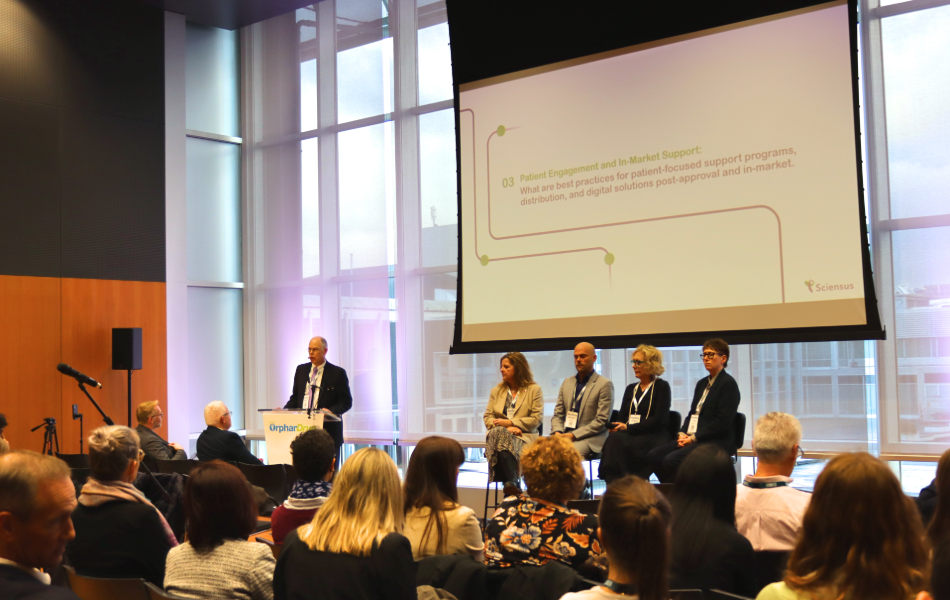
At the recent World Orphan Drugs Congress Europe, Sciensus’ Dr. Ray Huml, Vice President, Rare Disease Strategy, led a panel to discuss best practice for patient engagement and in-market support. He was joined by: Mathieu Loiseau, Director of Rare Clinical Services at Sciensus; Sophie Muir, CEO of Timothy Syndrome Alliance; Pat Furlong, President and Founder of Parent Project Muscular Dystrophy; and Lara Bloom, President and CEO of The Ehlers‑Danlos Society.
What effective patient support programmes look like
The key to any successful patient support programme (PSP), shared Pat Furlong, is a combination of awareness, visibility and flexibility.
“Support staff must be known and visible in the community, available 24/7 and educated on the disease and its progression,” she said.
Staff should remain flexible to individual patient needs and understand their complex access journeys by collaborating with advocacy groups. This is particularly true in the case of US Medicaid regulations – which vary state-by-state – and private insurance.
Centring patient voices as programmes scale
In her work, Pat pushes for community members to be included at every data and safety monitoring board (DSMB) and advisory committee. The organisation also co-runs focus sessions with advocacy groups and conducts preference studies across all ages and therapy types, ensuring patients can share what matters most to them.
“We train families to advocate within government and sustain a continuous two-way dialogue,” shared Pat. “Patient voice isn’t optional; it’s how progress happens.”
Make support structural, not symbolic
Patient support should be central to the journey of any rare disease drug, both pre- and post-approval. As Lara Bloom pointed out, timing and language matter.
“Lived experience must be present from the very beginning,” she said.
But there’s often an unfair expectation that patients should be fluent in medical jargon to share this lived experience. As one audience member pointed out, training patients to “speak the right way” could – alongside being an added expense – ultimately exclude them from sharing their experience.
While such training may have been required in the past, this is no longer the case. Clinicians are instead expected to meet patients where they are in their medical knowledge. “Today, the goal is to remove barriers so lived experience is welcomed without excess gatekeeping,” said Lara.
“People don’t need credentials to share their lived reality,” Lara concluded. “They need respect and meaningful seats in building the table, not just sitting at it.”
How to measure success
At Sciensus, Mathieu Loiseau leads both clinical and patient support programmes, centring patients’ lived experience. He is not only aware of the potential challenges in their implementation, but how to overcome them.
“Adherence is a known challenge; often around the 50 to 60% range for chronic conditions,” he shared. “Reasons are multi-factorial: from access and reimbursement to psychological factors like denial or forgetfulness.”
PSPs should proactively support adherence where it may otherwise fall short, for example, where new therapies create new challenges for patients and their families, like daily IV administration and life-planning support.
The success of these programmes is not measured only in usage metrics, but in how well patients’ practical needs are addressed.
Effective support in CACNA1C disorders
Sophie Muir founded the Timothy Syndrome Alliance when she learned one of her children had a CACNA1C gene variant. Having grown the alliance from 43 known cases to over 250, she knows the importance of patient advocacy groups.
“The patient group is the connective tissue,” she advised. “Use the advocacy group to convene a trusted, global, multilingual community; mirror and amplify what families do and keep communication going.”
Her concluding point was that effective PSPs give actionable feedback, helping providers improve their service and empower patients and families.
Digital tools and patient-reported data should help, not overwhelm
Nowadays, there’s a wealth of digital tools available to inform care provision. However, these invaluable tools and patient-reported data should be used with caution.
As Lara pointed out, the key is building technology solutions (particularly AI) with those who live with the condition in question to reduce misinformation.
Pat added that patient engagement should go both ways; data patterns should be shared with them, so they stay involved and contribute more. Agreements should be simple and data should be given back to patients wherever possible.
“Reaching the underserved through technology requires trust-building and meeting people where they are,” she said.
Sophie noted that engagement tools should be practical, accessible and easy to integrate into daily routines. Communities engage more strongly when they can see a clear benefit to that engagement.
This is reflected in Sciensus’ hybrid patient support programme, where intuitive digital tools, patient-reported data and nurse-led care are combined in a way that supports patients without overwhelming them and where real-world evidence shows this approach significantly improves adherence and persistence.
The role of advocacy organisations and communities
Discussion then turned to how advocacy organisations and communities can be woven into the post-approval process.
Pat said patients should have a presence everywhere – from governance through advocating for policy to preference studies.
“Scale requires infrastructure and training,” she shared, “But the goal is always to elevate lived experience as the deciding voice.”
Mathieu added, “The most effective collaborations with advocates start with listening and co‑design: recognising patient groups as partners with unique reach, trust and insight.”
Want to learn more?
Patient insights offer a wealth of information to help shape effective engagement and support, particularly in areas like lived experience and mental health. As a closing reflection, Ray suggested these insights should be used as a guide to more astute questions and, ultimately, better support.
The key take away from the session was that patients’ lived experience should be embedded early into the foundations of any new support programme. PSPs should fit around patients’ lives – rather than the other way around – with accessibility as a priority.
For more expert tips, regional insights and practical strategies from our experts in European rare disease launches, download our new Rare Disease Launch Insights Report.